Published 12/2025
Created by kognimori kognimori
MP4 | Video: h264, 1280×720 | Audio: AAC, 44.1 KHz, 2 Ch
Level: Beginner | Genre: eLearning | Language: English | Duration: 87 Lectures ( 11h 6m ) | Size: 4.13 GB
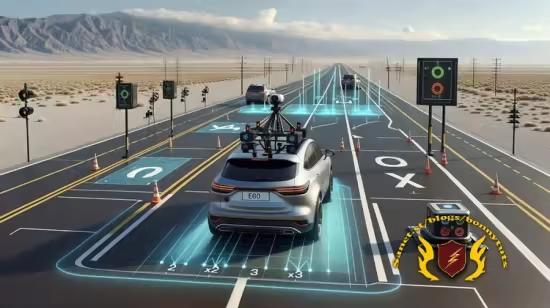
State estimation & sensor fusion from road data for self-driving cars, advanced driver assistance systems like EBA, ACC
What you’ll learn
See how driver-assistance and self-driving cars use camera, radar and other sensors to decide where things really are on the road.
Learn to talk about “chance” and “uncertainty” with simple numbers, so noisy sensor readings stop feeling mysterious.
Turn raw sensor readings into clean, usable signals that are easier to work with and reason about.
Understand how information changes over time (random processes) and why this is the beating heart of tracking cars, pedestrians, and robots.
Learn to combine many noisy readings into one confident “best guess” of where a target is and how fast it’s moving.
Step-by-step, build your own tracking “brain” in code that updates its guess every time new sensor data arrives.
See how a famous tracking method used in industry (Kalman filters) actually works, using simple pictures, stories, and code.
Practice with realistic ADAS scenes (lane keeping, following another car, crossing traffic, etc.) so every idea is tied to something you can imagine on the road
Learn to mix information from multiple sensors (like camera + radar) so the final answer is better than any single sensor alone.
Build an intuition that carries over to many fields—autonomous cars, drones, robots, and research—so you can read advanced papers later and actually understand
Requirements
Basic calculus & linear algebra
No advanced statistics needed— the initial sections bring everyone up to speed
Description
This course was built as a gentle but rigorous doorway into target tracking for driver assistance and autonomous driving. Rather than dropping learners directly into formulas, each idea is introduced through visual representations from road situations: crossing cars, hidden pedestrians, lane changes, slippery turns, and emergency braking events. Abstract symbols are always tied to something that could actually happen in traffic.The journey starts with probability from the level most people remember from school and carefully upgrades it for real sensor data. Uncertainty is explained as something that lives inside noisy camera, radar, ultrasonic sensors and lidar measurements. Random variables and distributions are presented as shapes that can be seen in the mind and on plots, not just in equations. Step by step, these shapes are combined to describe multiple sources of uncertainty acting at the same time.A dedicated section on random processes gives special attention to what makes real systems feel “alive” and changing. Random vectors, Markov and stationary behaviour, ergodicity and the law of large numbers are linked to moving vehicles, time-varying road conditions, and driver reactions. This part is designed to fix the common gap between textbook theory and how randomness shows up on the road and in real world applications.Signals and systems are then revisited with this probabilistic viewpoint. Intuition for impulse response, convolution, and state space models is tied to how sensors and ECUs actually treat incoming data. With this base, estimation techniques are introduced: minimum mean square error, least squares, finite impulse response filtering, adaptive methods such as gradient descent, and Bayesian ideas.Only after this scaffold is in place do Kalman filters appear. The standard filter is built as a natural consequence of everything before it, then extended to nonlinear motion through the extended Kalman filter. Each scenario is implemented in code and explored using simulator dashboards for crossing, parallel, oncoming, overtaking, and manoeuvring vehicles.By the end, learners see that many algorithms in modern automotive perception and control are simply estimation methods wrapped around random processes. The course is designed to serve as a solid base for later study of advanced Kalman techniques, reinforcement learning, and machine learning for autonomous systems.Every concept is supported by multiple relatable examples, slow build-up, and visual cues so that even first-time learners can follow alongside experienced engineers. The same language speaks to students, researchers, and professionals who wish to refresh fundamentals while seeing how they power intelligent vehicles on real roads.Additionally, the concepts explained in this course at not limited to autonomous driving, autonomous cars or self-driving cars technologies and ADAS domains. Since, this course aims to cover the intuition behind the usage of Stochastic or Random Processes, it can be used to understand the fundamentals of estimation as present in aerospace, robotics and industrial control applications. Disclaimer : AI was only used to generate a few images in this course© 2025 Kognimori
Password/解压密码www.tbtos.com
转载请注明:0daytown » Mastering Target Tracking for ADAS / Autonomous Driving