Data Science: Deep Learning in Python
Size: 761.42 MB | Duration: 6,5 hours | Video: AVC (.mp4) 1280×720 30fps | Audio: AAC 48KHz 2ch
Genre: eLearning | Language: English | + Examples, VTT
A guide for writing your own neural network in Python and Numpy, and how to do it in Google’s TensorFlow.
• How to take partial derivatives and log-likelihoods (ex. finding the maximum likelihood estimations for a die)
• Don’t worry about installing TensorFlow, we will do that in the lectures.
• Install Numpy and Python (approx. latest version of Numpy as of Jan 2016)
• Being familiar with the content of my logistic regression course (cross-entropy cost, gradient descent, neurons, XOR, donut) will give you the proper context for this course
This course will get you started in building your FIRST artificial neural network using deep learning techniques. Following my previous course on logistic regression, we take this basic building block, and build full-on non-linear neural networks right out of the gate using Python and Numpy. All the materials for this course are FREE.
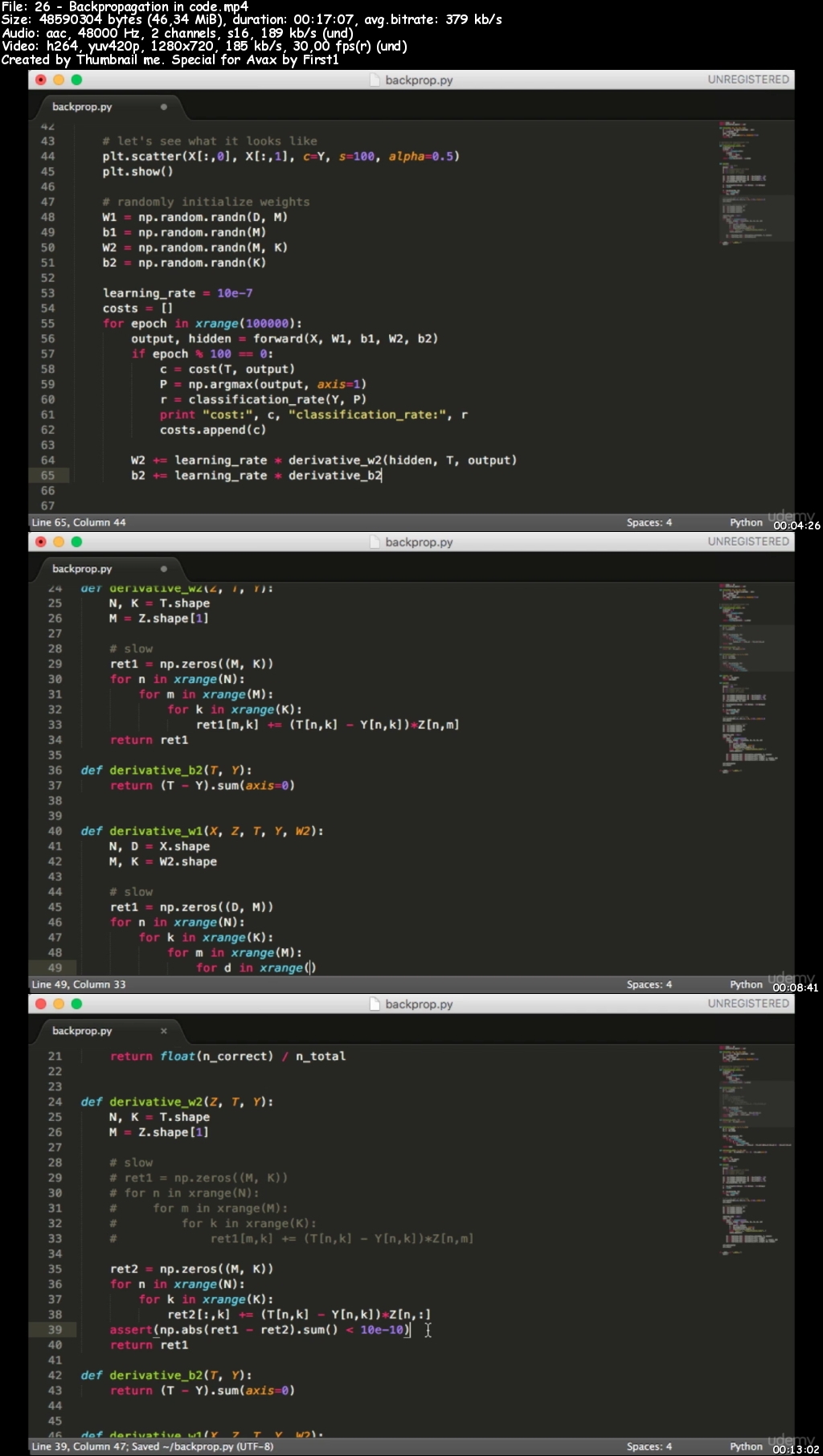
We extend the previous binary classification model to multiple classes using the softmax function, and we derive the very important training method called “backpropagation” using first principles. I show you how to code backpropagation in Numpy, first “the slow way”, and then “the fast way” using Numpy features.
Next, we implement a neural network using Google’s new TensorFlow library.
You should take this course if you are interested in starting your journey toward becoming a master at deep learning, or if you are interested in machine learning and data science in general. We go beyond basic models like logistic regression and linear regression and I show you something that automatically learns features.
This course provides you with many practical examples so that you can really see how deep learning can be used on anything. Throughout the course, we’ll do a course project, which will show you how to predict user actions on a website given user data like whether or not that user is on a mobile device, the number of products they viewed, how long they stayed on your site, whether or not they are a returning visitor, and what time of day they visited.
Another project at the end of the course shows you how you can use deep learning for facial expression recognition. Imagine being able to predict someone’s emotions just based on a picture!
After getting your feet wet with the fundamentals, I provide a brief overview of some of the newest developments in neural networks – slightly modified architectures and what they are used for.
http://ul.to/fd8um1i1
Download nitroflare
http://nitroflare.com/view/702EF8973FDF3DB/Data.Science.Deep.Learning.in.Python.rar
你是VIP 1个月(1 month)赞助会员,
转载请注明:0daytown » Data Science: Deep Learning in Python
与本文相关的文章
- Python 3 OOP: Master Python Object Oriented Programming
- Python for VLSI Engineer P2 : Understanding COCOTB
- Building Powerful AI Marketing Automation with OpenAI API
- Backend Systems Design
- AUTOSAR Application Software Layer Course (ASWL) | english
- Ultimate Lighting Course – In-Depth Tutorial
- Flutterflow: Le cours complet – Le no code iOS & Android
- Support Vector Machines in Python: SVM Concepts & Code
- Logistic Regression in Python
- RESTful API with Angular & Django: Learn CRUD & AUTH
- Machine Learning Primer with JS: Regression (Math + Code)
- Create Desktop Game For Beginner with Unity Engine & C#