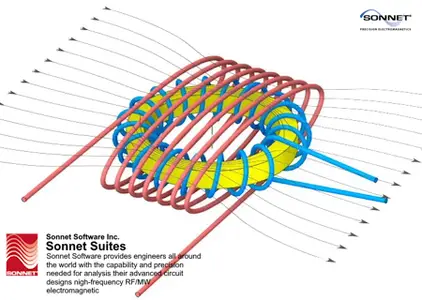
- Beowulf 求解器(测试版):这是业界首创的全精度、加速型矩量法 (MoM) 求解器,能以更高速度和更低的内存消耗分析大规模电路。
- 性能大幅跃升:专业标准版的线程数提升至 8 个,高性能版提升至 64 个,并全面支持 AVX512 架构,极大提升计算效率。
- 现代化文档系统:采用全新的文档系统,由工程师实时更新,提供直观易用的在线查阅体验。
- 集成与扩展增强:支持宏命令的 XML 格式、命令行绘图优化以及 Derived Tech Layers(衍生工艺层)等增强功能。
Sonnet Software Inc. announces the availability of the SONNET Suites Professional Release 19.54. This software provides commercial EDA software solutions for high-frequency RF/MW electromagnetic analysis.
This version is a minor update to Sonnet version 19.52.2025. Below you will find a summary of the main improvements that are included in this version.
Multi-threading performance improvements: The EM solver’s multi-threading performance has been substantially improved.
Conformal Mesh improvements: The Conformal Mesh meshing model has numerous fixes and improvements.
Enhanced Resonance Detection improvements: The Enhanced Resonance Detection algorithm has numerous fixes and improvements.
More efficient quadruple precision for Windows: The previous Sonnet version (19.52.2025) introduced support for multi-threaded quad precision calculations, but quad precision in Windows was much slower than in Linux. In this release, quad precision for Windows is still slower than on Linux, but it is a lot faster in this release than in previous releases.
Macro language additions: Sonnet’s macro language now includes the ability to specify symmetry, reference planes, variable units, tables for dielectrics, Technology Files, and advanced EM solver options such as de-embedding, compute currents and subsectioning controls. In addition, Get and Fetch commands have been added to retrieve information about your project.
DXF/GDSII import improvements: Several improvements were made to the DXF/GDSII import process.
– The import wizard now allows the user to view the number of polygons associated with each layer.
– A new option, “Flatten Project”, has been added. It will process Derived Layers and Precedence when using a template file for import.
– A new option, “Clean Geometry” has been added. It will remove redundant points and polygons from your imported project.
– The speed of the translation process has been improved significantly.
Layer Mapping menu added to Project Editor: A new menu item has been added to the Project Editor: Circuit > Mapping. When translating to or from third-party tools such as Keysight ADS or artwork formats such as DXF, GDSII, or Gerber, each CAD layer you wish to translate must be mapped to a Sonnet Tech Layer. This mapping information may be stored in the Technology File or your project file. You may edit this information by editing the properties of the Tech Layer. However, this process can be tedious when editing multiple Tech Layers. To aid you in this process, a mapping tool has been added to the Project Editor and can be accessed by selecting Circuit > Mapping.
New Derived Tech Layers features: Several new features have been added to Derived Tech Layers.
– Derived Tech Layers may now refer to other Derived Tech Layers.
– Any source layer used by a Derived Tech Layer may be automatically deleted after flattening. See Remove After Flatten.
– The OR and DIFF operations can be set to only affect overlapping polygons.
– You may create a flattened project by selecting File > Export > Flattened Project from the main Project Editor menu.
Enhanced command line support: Opening a graph or pattern from the command line has been enhanced to support using a template file.
Compatibility: This Sonnet version is completely compatible with Sonnet 19.52.2025 unless your project file contains a new feature that is only available in Sonnet 19.54.2026. Sonnet 19.52.2025 will ignore any new features such as the new Derived Layer features.
The following list contains minor enhancements and changes that were suggested by our users and have been implemented in this release.
13342 Improve meshing speed.
14291 Improve EM solver multi-threading performance.
14287 Improve Windows quad precision speed.
14303 Enhance graph and pattern command line to support a template file.
3119 Add option to Import Wizard to “clean” the geometry.
4064 Enhance ABS sweeps to use impedance system of project for the convergence criterion.
7729 Enhance GDSII import to show structure names alphabetically.
10758 Enhance netlist projects to include Enhanced Resonance Detection (ERD) capability.
14166 Enhance DXF/GDSII translator export so it can export port information.
14299 Enhance graph options to allow changing precision of parameter values in status bar.
14133 Improve warning messages when communication is lost between remote EM server and client.
14282 Improve wording of message when computer does not have enough RAM to simulate a project.
14284 Modify EM solver to use the maximum number of threads allowed by the license, regardless of hardware.
14302 Ask user if they want to delete pre-computed data when they make a minor change and save the project.
14336 Add capability to Cluster Computing initialization file to allow setting the number of split frequencies.
14334 Add capability to session tab to clear the recently used project and session lists.
Sonnet’s suites of high-frequency electromagnetic (EM) Software are aimed at today’s demanding design challenges involving predominantly planar (3D planar) circuits and antennas. Predominantly planar circuits include microstrip, stripline, coplanar waveguide, PCB (single and multiple layers) and combinations with vias, vertical metal sheets (z-directed strips), and any number of layers of metal traces embedded in stratified dielectric material.
Did you know that permittivity is dependent on the direction of fields? This is called anisotropy, and not only does Sonnet support this in analysis, but we have developed a technique to characterize material as well. If you need accurate simulation, this tutorial is for you.
Founded in 1983 by Dr. James C. Rautio, Sonnet Software Inc. is a private company dedicated completely to the development of commercial high frequency EM software. Sonnet maintains a single, dedicated focus on providing the industry’s most accurate and reliable high frequency planar EM software. Sonnet Software, Inc. is based in Syracuse, NY, USA with representatives across the globe.
Сopyright holder \ Distributor: Sonnet Software Inc.
Product Name: Sonnet Suites
Version: 19.54.2026 Professional
Supported Architectures: x64
Website Home Page : http://www.sonnetsoftware.com
Languages Supported: english
System Requirements: Windows & Linux *
Size in archive: 1.6 Gb

转载请注明:0daytown » SonnetSuite 19.54 Win/Linux