Published 3/2026
Created by Sime Bugarija
MP4 | Video: h264, 1280×720 | Audio: AAC, 44.1 KHz, 2 Ch
Level: Beginner | Genre: eLearning | Language: English | Duration: 15 Lectures ( 3h 39m ) | Size: 2.9 GB
Your all-in-one masterclass for enhancing your Blender compositor workflow using Layers and Scenes
What you’ll learn
✓ Learn how to use Blender’s compositor workflow with Layers and Scenes.
✓ I will introduce you to tools such as layers, scenes, toggles, render passes, OpenEX, color management, light linking, light groups, import methods, library ov.
✓ For example, with a proper setup, you can completely transform the look of your render — without re-rendering from realistic to stylized
✓ For example, we can re-render only the layer that we changed — saving massive amounts of time
Requirements
● Nothing special, Free Blender program and internet
Description
Your all-in-one masterclass for enhancing your Blender compositor workflow using Layers and Scenes
There are a large number of blender courses that cover the basic things like modeling, texturing, lighting, or, in general, scene creation…and I’ve made a few of them myself.
But not many tutorials go deep into scene organization
In this course, we’ll cover topics such as working with layers, scenes, toggles, render passes, OpenEX, color management, light linking, light groups, import methods, library overrides… and more.
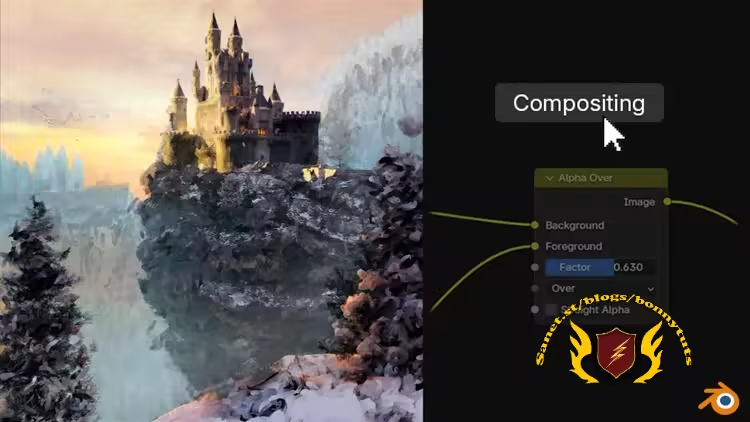
For example, with a proper setup, you can completely transform the look of your render — without re-rendering from realistic to stylized, even paint-style looks — all done directly in the compositor with just a few sliders
When working on small or simple scenes, this might not seem very important. But as more details are added to the scene, it becomes large and complex
Without a proper organization, your Blender file can quickly become heavier, slower, and harder to manage. That’s where understanding how to break a scene into layers becomes important.
Not just to keep things organized, but to keep your viewport and render fast, stay flexible, and gain much more control later in the compositor.
For example, we can re-render only the layer that we changed — saving massive amounts of time
So this is a course about Layers, Scenes, Passes, Toggles, OpenEX and how they all work together in a Blender compositor
Along the way, we’ll also cover topics such as light linking, light groups, the difference between import methods, library overrides, and more.
We’ll also talk about how to move your renders into other compositing software like After Effects or DaVinci Resolve and how to set up color management correctly. (This part is optional because we are using Blender Compositor as the main tool).
ASSETS INCLUDED
Since we added more details to the scene with my Geo nodes modifier Super Scatter on Surface, I decided to offer you the option to purchase the modifier at half price.
Scatter on Surface is a new modifier that has become Blender’s primary scattering tool since Blender 5, However, it comes with one drawback — it’s empty by default. But Super Scatter on Surface, my version of the modifier, fixes that; you get the same modifier but fully populated with high-quality photoscan assets covering over 20 categories.
10 TREES
In addition, you will receive 10 detailed trees as a gift that you can save in the asset browser for your future projects.
Of course, the project files and resources needed to follow the tutorial are also included.
 Password/解压密码www.tbtos.com
转载请注明:0daytown » Mastering Layers, Scenes & Compositing in Blender