Published 3/2026
MP4 | Video: h264, 1280×720 | Audio: AAC, 44.1 KHz, 2 Ch
Language: English | Duration: 4h 31m | Size: 3.98 GB
Animate realistic heavy quadrupeds in Maya using biomechanics, blocking, secondary motion, and spline polish
What you’ll learn
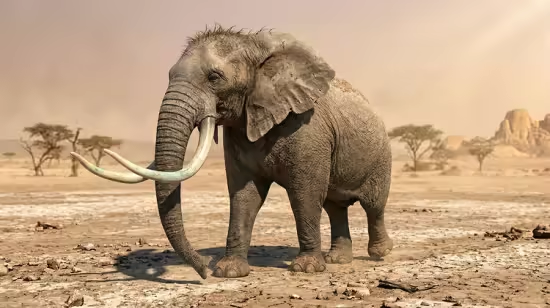
Animate a realistic Elephant Walk Cycle in Autodesk Maya, focusing on weight distribution, stride rhythm, and grounded locomotion.
Block a heavy quadruped walk cycle using strong contact poses, proper foot placement, and clear timing.
Apply real-world elephant biomechanics and anatomy principles to improve believability in creature animation.
Refine animation curves in the Graph Editor to achieve smooth weight transfer and natural body sway.
Add secondary motion including trunk drag, ear overlap, and subtle tail follow-through for enhanced realism.
Polish a professional-quality elephant walk cycle suitable for inclusion in an animation demo reel.
Requirements
Basic understanding of Autodesk Maya interface and navigation.
Access to Autodesk Maya 2019 or newer.
Basic understanding of animation principles such as timing and spacing (helpful but not mandatory).
No prior creature animation experience required — beginners and intermediates are welcome.
Description
Learn how to animate a realistic Elephant Walk Cycle in Autodesk Maya using professional creature animation techniques.
Animating heavy quadrupeds is one of the most challenging and rewarding skills in 3D animation. Elephants move with immense weight, controlled balance, and slow, powerful stride mechanics that require a deep understanding of biomechanics, timing, and weight transfer. In this course, you’ll learn how to animate a believable elephant walk cycle from start to finish using a structured, production-style workflow.
We begin with reference analysis and rig exploration to understand real-world elephant locomotion. From there, you’ll move into blocking, where you establish strong contact poses, correct foot placement, and accurate stride rhythm. You’ll refine body mechanics, torso sway, and head motion to reinforce mass and grounded movement.
As the course progresses, you’ll add secondary animation including trunk drag, ear overlap, and tail follow-through—essential elements for realistic creature animation. Finally, you’ll transition into spline refinement inside Maya’s Graph Editor, polishing curves and improving flow to achieve demo-reel-ready quality.
This course is ideal for beginner to intermediate animators who want to improve their quadruped animation skills and strengthen their understanding of weight, balance, and biomechanical motion.
By the end of this course, you’ll have a polished elephant walk cycle suitable for your animation portfolio, VFX reel, or game animation showcase.

转载请注明:0daytown » How to Animate an Elephant Walk Cycle in Maya