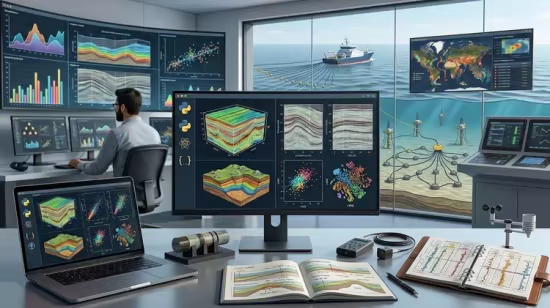
本课程是一门零基础起步、专注于地球科学领域的 Python 与人工智能实战指南。课程依托 Jupyter Notebook 交互式环境,带你全面掌握 NumPy、Pandas、Matplotlib、SciPy、Scikit-learn 以及 TensorFlow/Keras 等核心数据科学与深度学习工具。通过对真实世界地学数据集的清洗、可视化与建模,你将亲手构建起用于岩性自动分类、储层参数表征、环境监测、天气预测及矿产勘探的预测模型,最终具备将数据驱动技术独立应用于学术研究和地学工业界前沿问题的实战能力。
Published 7/2026
MP4 | Video: h264, 1920×1080 | Audio: AAC, 44.1 KHz, 2 Ch
Language: English | Duration: 14h 31m | Size: 7.44 GB
Master Python programming, data analysis, visualization, and machine learning techniques for solving real-world problems
What you’ll learn
Build a strong foundation in Python programming for geoscience applications.
Work with real-world datasets using Jupyter Notebook.
Develop predictive models for lithology classification, reservoir characterization, and environmental analysis.
Apply supervised and unsupervised machine learning algorithms to real geoscience datasets.
Complete practical projects that can be applied in academic research and industry.
Requirements
No prior programming experience is required.
Basic knowledge of geology or geophysics is helpful but not mandatory.
An eagerness to learn Python and machine learning through practical applications.
A computer running Windows, macOS, or Linux.
Internet connection for downloading datasets and software.
Description
Artificial Intelligence (AI), Machine Learning (ML), and Python programming are transforming the way geoscientists analyze, interpret, and model Earth science data. From seismic interpretation and lithology classification to reservoir characterization, environmental monitoring, weather prediction, and mineral exploration, modern data-driven techniques have become essential tools for both research and industry. This course is designed to bridge the gap between geoscience and artificial intelligence by providing a practical, hands-on approach to Python programming and machine learning using real-world geoscience datasets.
The course begins with Python fundamentals and gradually progresses to data analysis, visualization, and machine learning. You will learn how to work with scientific libraries such asNumPy for numerical computing,Pandas for data manipulation,Matplotlib andSeaborn for data visualization,SciPy for scientific computing and statistical analysis, andScikit-learn for building machine learning models. You will also receive an introduction to deep learning with TensorFlow and Keras to solve more advanced geoscience problems.
Throughout the course, you will develop practical skills by implementing a wide range of machine learning algorithms. These includeLinear Regression,Multiple Linear Regression,Logistic Regression,Decision Trees,Random Forest,K-Nearest Neighbours (KNN),Support Vector Machines (SVM),Naïve Bayes,Gradient Boosting,XGBoost,AdaBoost,Principal Component Analysis (PCA),K-Means Clustering,Hierarchical Clustering,DBSCAN,Fuzzy C-Means,Apriori Association Rule Mining,Artificial Neural Networks (ANNs),Convolutional Neural Networks (CNNs),Long Short-Term Memory (LSTM) networks, and other modern deep learning techniques used in geoscience research.
Rather than focusing solely on theory, this course emphasizes real-world applications using practical examples and downloadable Jupyter notebooks. You will learn how machine learning can be applied tolithology classification,well log analysis,seismic facies classification,fault detection,weather prediction,crude oil production forecasting,groundwater quality assessment,earthquake analysis,landslide susceptibility mapping,remote sensing image classification, andenvironmental data analytics.
Each topic is explained step-by-step, making the course suitable for beginners while also providing sufficient depth for researchers and professionals. By the end of the course, you will have the confidence to develop your own machine learning workflows, analyze complex geoscientific datasets, and apply artificial intelligence techniques to solve real-world Earth science problems.
Whether you are a student, researcher, educator, or industry professional, this course will equip you with the computational and analytical skills needed to harness the power of Python and machine learning in modern geoscience.
Who this course is for
Beginners who want to learn Python through geoscience examples
Industry professionals seeking AI skills
University lecturers and educators
Data scientists interested in geoscience
Geoscience, Earth Science learners
 Password/解压密码www.tbtos.com